
Growing Tuber aestivum / uncinatum
Truffles are the edible fruiting bodies of a type of subterranean fungus, which form symbiotic relationships with a host tree. Symbiosis is a beneficial association for both organism, fungi and host. With mycorrhizae efficiency of soil nutrient, the uptake increases, resistance to stress, higher growth, and a better use of the soils.
Among Tuber species of culinary interest, T. aestivum / uncinatum, displays the most extensive geographic range and is found in almost all European countries. The ecological and pedo-climatic requirements of the Burgundy truffle confer to this species an increased capacity to adapt to many environments.
The Summer/Burgundy truffle can be found in soils with a large variety of textures. Suitable soils are neutral or slightly basic, lime and organic matter rich soils of good water management with clay content up to 45%.
Plantation quality is an essential condition for a good truffle orchard growth.
You need to ensure your land and climate are suitable for truffle production. Having access to a specialized laboratory we can analyze your soil and have this relevant data available to you.
Our visit on your fields will give us an idea, added to the analysis, of what possible corrections you can do to maximize your results. All the collected data should help to conclude if the land is or is not favorable for truffle production.

Soil preparation must be done at the most appropriate time and performed with care. Get a breeding ground for the fungus and the tree by making the necessary corrections without upsetting the structural layers of the soil. The soil preparation techniques may vary depending on the ground and crop history of your land : vine, fallow, cereals etc.
Avoid recent deforestation, because there are risks of competition with other ectomycorrhizal fungi.
For best results, the right choice of plant species is crucial. The rule is to plant what naturally thrives in your particular ecosystem. Choosing the right combination of inoculate plants requires wisdom as you can take into account the longevity of oak, the stability of hornbeam or the earliness of hazel, for example.
For the Summer/Burgundy truffle shadowy areas are important, thus a high plantation density of 1000 – 2000 plants / hectare (5m x 2m, 2,5m x 2,5m, 2m x 3m, 2m x 2m) is to be taken into consideration. Planting can only be done in frost-free ground early spring or autumn. Autumn planting is more advantageous if the early frosts can be avoided.
Soil management techniques can be required and the ones currently used are irrigation, mulching, soil tilling as these can partly compensate for the possible water deficits of summer. The high soil water availability is favorable to fruiting body production by decreasing water stress during drought periods. Combining irrigation and mulching also contributes to improved control of soil water availability.
Mulching is beneficial to decrease soil temperatures in summer and to increase soil moisture by mulching with black plastic, cork sheets or with natural fibres (jute, for example) can then be installed to maintain a clean soil around the plant during the first years. You should avoid grass and hay as it can attract mice and has often been treated with undesirable fungicides.
Fruiting starts from the 4th or 6th year in case of the hazelnut and for oak, linden 6th or 9th year.During production, irrigation should allow a good yield of truffles and keep alive mycorrhizae. Irrigation will be managed according to its ecological cycle but also the type of soil.
The truffles will be larger if the ground is soft. A light tillage especially if the ground is compacted is recommended. It is performed with the same rake, always at the same depth. This is done after the harvest of the truffles and before the next crop. This will in addition allow the spring rains to better penetrate the soil whilst also limiting the summer evaporation.

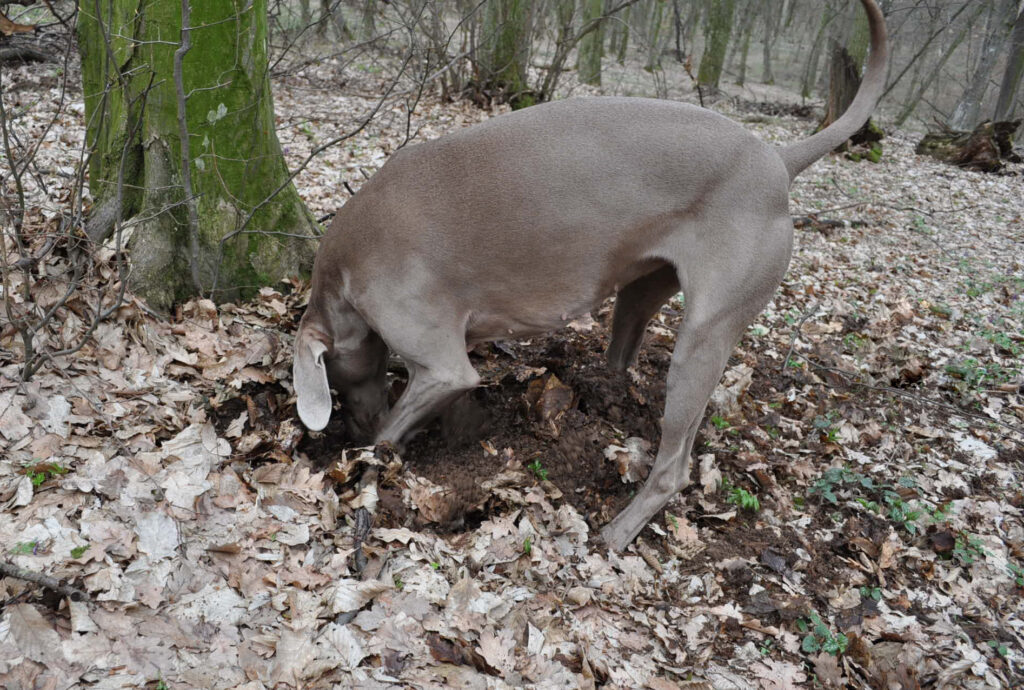
For Tuber aestivum / uncinatum the harvest period is from June to December.
The basic rule of collection is that only the mature mushrooms needs to be collected. This is where a trained truffle dog can come in handy.